
Minimaldatensatz (DDB)
Recording with authority data
You catalogue in your usual input form or in the form of the Minimaldatensatz; the export reads the fields, not the forms.
Record terms with URIs
As you type in an authority data field, matches from the institution’s authority data library appear on the left, and matches from the field’s vocabularies on the right. One click takes over the term and its URI. Each term exists once in the library and is used by every object that carries it (film ).
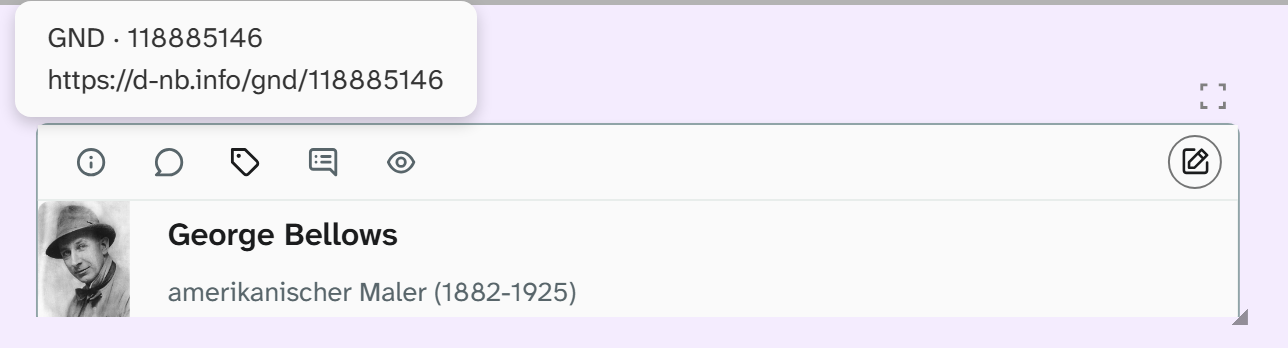
Moliri comes with more than 20 vocabularies. The selection is based on the publication “FAIRe Vokabulare und Normdaten für Museen und Sammlungen” (FAIR vocabularies and authority data for museums and collections, version 1.0.1, 2026):
| Information in the Minimaldatensatz | Vocabularies in Moliri |
|---|---|
| Persons and corporate bodies | GND, Wikidata, Getty ULAN |
| Places | GeoNames, Getty TGN, GND, Wikidata, iDAI.gazetteer |
| Object name | Objektbezeichnungsdatei (OBG), Getty AAT, GND, Wikidata |
| Classification | Hessische Systematik, Hornbostel-Sachs, Iconclass, GND |
| Material and technique | Getty AAT, GND, Wikidata |
| Subject keywords, depicted content | Iconclass, GND, Getty AAT, Wikidata |
| Event type | LIDO Terminology |
The administration chooses which vocabularies a field offers under Data model › Fields: open the field, section Vocabularies (sources in the finder). Without a selection the field searches GND and Wikidata. Authority data fields that Moliri creates for the Minimaldatensatz already have the recommended vocabularies preselected.
The administration adds further sources under Libraries › Authority data, tab Sources, with Add source, with no limit on their number:
| Type | What it provides |
|---|---|
| Search file | An uploaded file: a Moliri search file (.json) or an md:term dump (.zip) |
| JSKOS interface | Vocabularies from JSKOS services, such as DANTE |
| Skosmos interface | SKOS vocabularies behind a Skosmos instance |
| md:term vocabulary | A vocabulary from museum-digital |
| Reconciliation interface | Services following the W3C Reconciliation API |
On top of these comes the local vocabulary, whose terms are maintained in Moliri itself. Enabled for this instance switches each source on or off for all fields.
Convert existing text
If terms are already there as text, for example from an old database or an Excel list, Check › Resolve references › Resolve field turns them into authority data. Identical spellings are grouped, sorted by frequency and given suggestions. You decide once per spelling, not per object (Resolve references ). Unclear values from the Excel import appear in the same window under From import.
Dimensions from free text
The Minimaldatensatz expects dimensions as a number with a unit, separately for height, width and depth. If the size is only there as text (“Blatt 34,5 × 47 cm”, sheet 34.5 × 47 cm), the instance’s language model suggests the numbers: Check › AI suggestions, bar Dimensions from free text, Order …. Each number is checked against the quoted passage of text and is only taken over once someone accepts the suggestion. Details: Dimensions from free text .
Find gaps
In the sidebar, tab Check, Completeness for standard exports shows how many objects in the current filter meet the Minimaldatensatz and which information is missing for how many of them (film ).
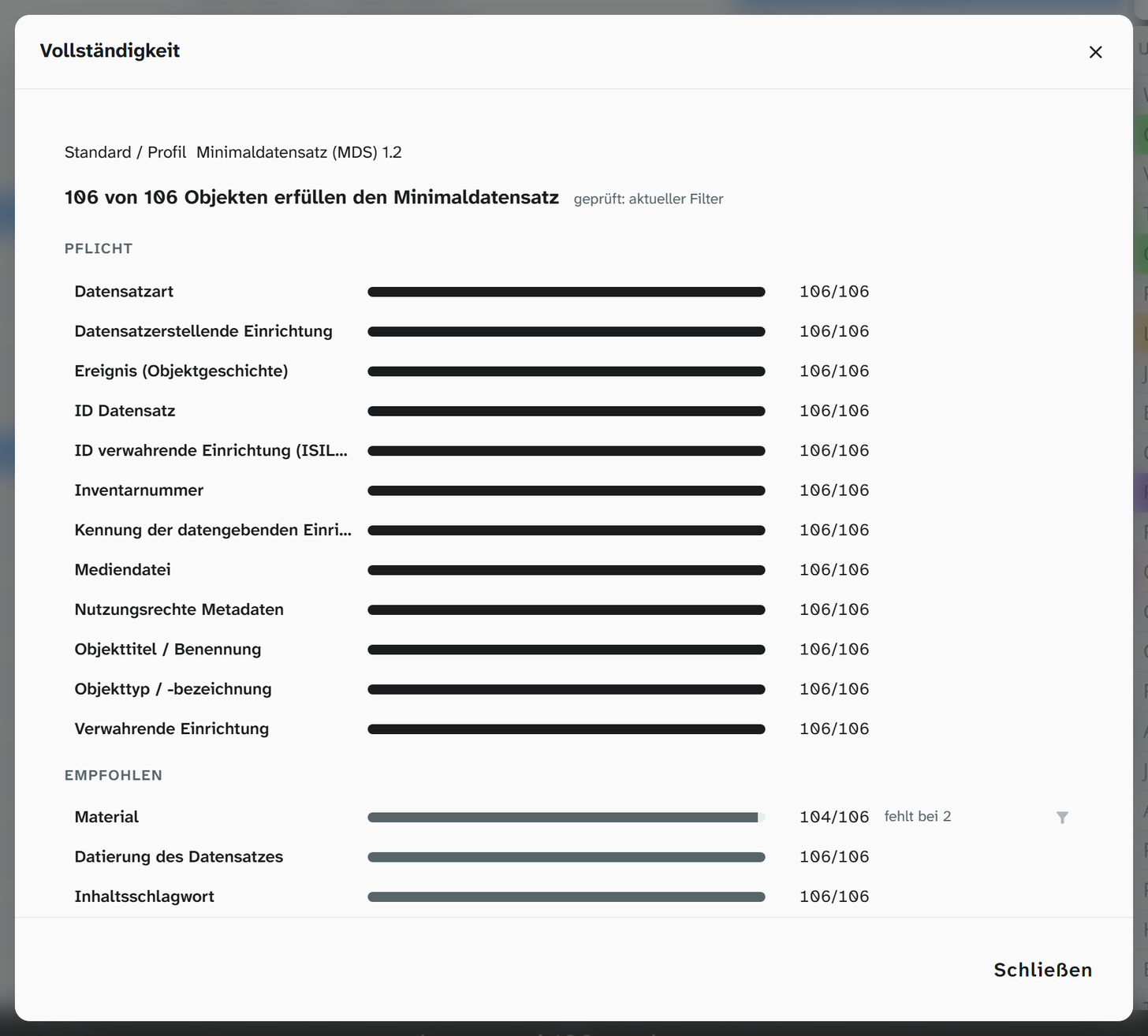
A click on a gap filters the objects affected. You can fill them in one by one or with bulk edit .